The Basics
Water used to flush toilets does not need to be treated to drinking water standards. Water reuse collects previously discarded water flows (i.e. alternative water sources) and treats them to the quality deemed safe for their intended end use. Tailoring treatment to the intended end use, referred to as fit-for-purpose treatment, saves the energy and chemicals associated with overtreatment to drinking water standards when the end use does not require it.
In 2019, the US EPA, other federal partners, and water stakeholders across the country came together to create a national Water Reuse Action Plan (WRAP). The WRAP's online platform provides the most up-to-date information on coordinated efforts to drive consideration, adoption, and implementation.
**Please check state and local regulations to see which sources can be collected, how they can be used, and what the applicable water standards are for your area.
End Use Applications
Scale: Onsite v. Centralized
Alternative Water Sources
Please check state and local regulations to see which sources can be collected, how they can be used, and what the applicable water standards are for your area.
Treated Municipal Wastewater
Treated wastewater effluent discharged from a centralized wastewater treatment plant of any size. Other terms referring to this source of water include domestic wastewater, treated wastewater effluent, reclaimed water, and treated sewage.
Stormwater
Precipitation that is collected from land or impervious surfaces at a district or regional scale for the purpose of beneficial reuse. Rainwater collection at the building scale is classified separately under 'onsite collected waters.’
Industry Process Water
Water produced during industrial and manufacturing processes. Other terms referring to this source of water include air handling condensate, boiler, cooling or wash water, and water generated during oil and natural gas extraction.
Onsite Collected Sources
Water sources generated within or surrounding a building or district. Definitions for onsite-collected rainwater, stormwater, greywater, blackwater, air conditioning condensate, and foundation drainage are shown in the image below.
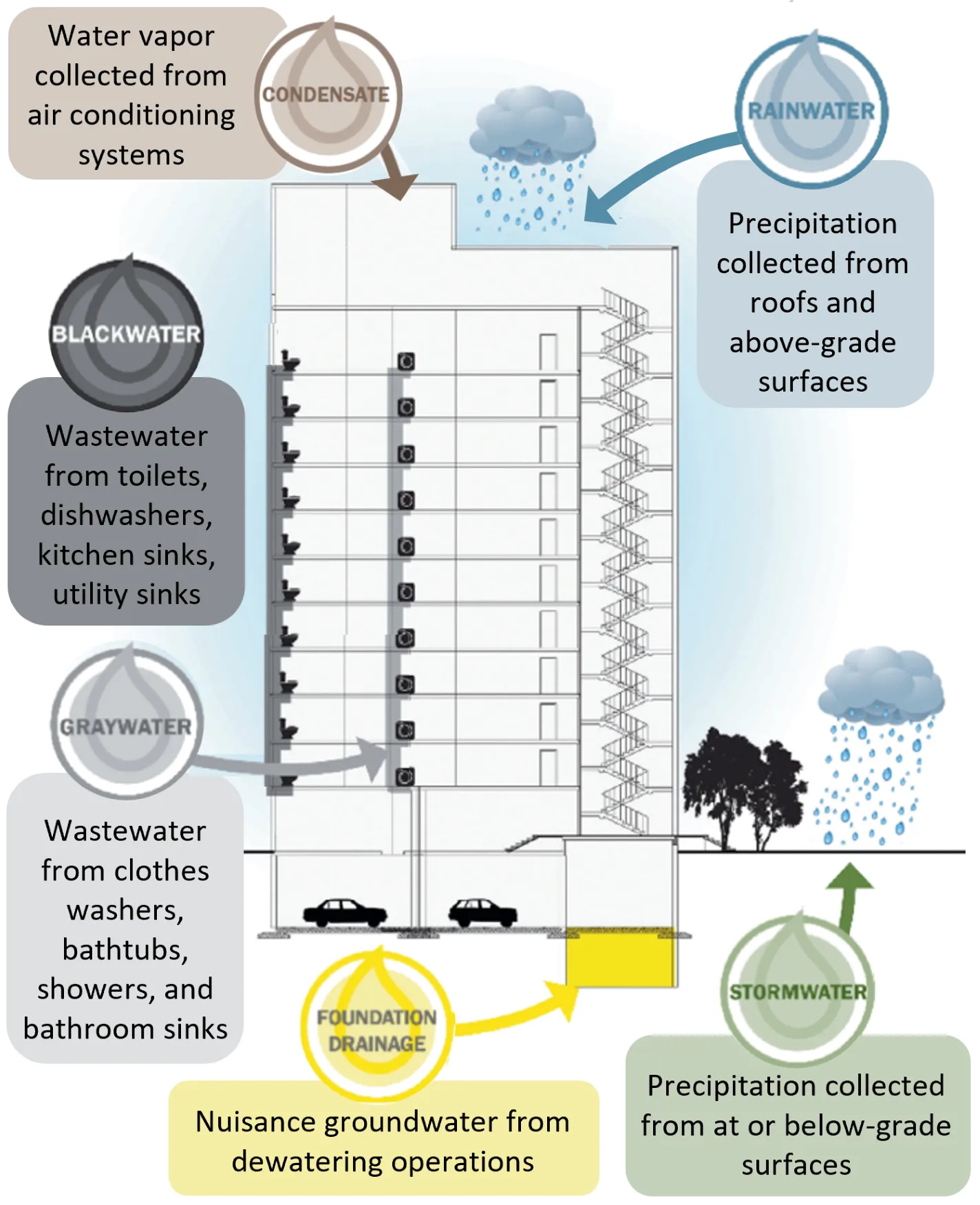
Original Photo Credit: San Francisco Public Utilities Commission
How the Water Can Be Used
Please check state and local regulations to see which sources can be collected, how they can be used, and what the applicable water standards are for your area.
A major part of water reuse is the "fit-for-purpose" treatment. By treating the water we've collected to match the way we plan to use it, ??
Indoor Non-Potable End Uses
Outdoor Non-Potable End Uses
Other Non-Potable Uses
Scale
Onsite and distributed systems collect sources close to where they're generated and treat water close to where it's used. They include individual buildings and clusters or groupings of buildings, referred to as districts. Their decentralized nature has extra benefits:
Onsite systems keep working when extreme events interrupt centralized services.
Faster and easier to implement. Capacity can be added as needed, rather than building out for uncertain future needs.
Nutrient and energy recovery is easier from more concentrated waste streams. Net energy savings (location-dependent) mean lower environmental impacts.